I know I’ve been a bit dormant (7 years), but it’s time to start creating again.
New content is coming!
Leave a reply

I know I’ve been a bit dormant (7 years), but it’s time to start creating again.
When I was in high school, I had a great English teacher. She was wonderful for many reasons, but one in particular still stands out to me was that she was so passionate about literature and wanted to spread that passion to all the students in her class. I remember the introductions to books I’d never heard of, and many more that I didn’t want to read, but after each presentation we could not help but be affected by that contagious passion. There was something valuable in each book, and it was our duty, no, our pleasure to seek it out.
 Besides instilling passion into the young, malleable mind of an adolescent, another primary role of a teacher is to gain the trust of a student. The student inevitably asks “Will I ever use this?” or “What is this for?” and generally they receive the same pat answer, “Just trust me.” The teachers who are able to lead students from that lazy response to a real and exciting understanding of trust that is won over and are truly the great ones.
Like many students, I saw my summer reading list for English and gasped with despair. Not just the quantity of books on the list, but the appearance of so many dreaded titles: “As I Lay Dying” by William Faulkner, ” “The Grapes of Wrath.” by John Steinbeck and “Pride and Prejudice.” by Jane Austen. We all were familiar with them, and besides not wanting to spoil the freedom of our summer bliss, we really didn’t want to commit ourselves to the drudgery of wading through complicated prose. I had loads of other great books I wanted to read, and I had no expectations of letting the reading list mandate my literary consumption.
To my surprise, I read all of them. Not just skim over them, but really read them. At the time, I just did it. I don’t know if I was trying to be a good son or a student, but I was curious why she put the books on there and why she encouraged us to find some great thing in each book. I think what she alluded to is that if we searched for greatness we would be pleasantly surprised.
Now, some of that curiosity diminished over the course of each book because there were quite a few occasions where I was fumbling through some dense chapters, i.e. the stream of consciousness of the members a southern family, and simply gave up at the moment. Part of me still doesn’t understand why it’s as popular as it was. That’s ok though, because by and large I am a better person for finishing that summer reading list and completing “As I Lay Dying.”
Later on that year, to my delight, there was a wildcard choice on that reading list, “The Lords of Discipline” by Pat Conroy. Now, here was a book I could actually enjoy. It was about real things in life. Real boys doing real things in a real place. Growing up and fighting through a rite of passage when it wasn’t easy and the environment didn’t support you.
I understood that and felt myself identifying with Will McClean as he faced his first year as a “plebe” at the fictional Carolina Military Institute. To me, that felt like my freshman year at my high school. Luckily for me, I didn’t have to experience the same excruciating physical trials Will had to go through, although my basketball practices verged on a lighter form of this kind of punishment, and a greater differentiator in my case, we had girls at my high school. (But it’s not like I talked to them anyway.)
If there’s one thing I can say about “Lords of Discipline” is that it grabbed me. Early on in the book, those overpowering military arms grabbed my shirt with both hands and pulled me face first into that “Lesesne Gate” onto campus. Before I knew what was happening, I tried to regain my balance, but received a swift kick in the rear which sent me flailing into into that pristinely manicured green. I could taste the bitter grass in my teeth and when I regained my senses I looked up to appreciate the blinding white facades of grand military buildings from the fictionalized institution. From this vantage point, I was truly a lowly first year.
I had forgotten that a book could really throw you around and make you lose a sense of self and orientation to the real world in which you inhabited. This one made my knees bleed from repeated falls from exhaustion and blisters sprouted under the balls of my feet from miles of marching in standard military issue boots. I remember feeling like my body ached after reading the detailed regimen of daily punishment, er “training exercises,” and feeling the injustice of deliberate sleep deprivation. All of those real bodily symptoms affected me and I had to train my body to this new physical demand, and with Will I eventually did.
Almost naturally, Will’s comrades, Mark, Pig (Pignetti), and Tradd, his brothers in the fight, became my friends. I knew their backgrounds, their motivations and desires, and their northern and southern accents sounded in my ears when they spoke. I wanted to know not just what was happening to Will, but what was going to happen to them too. How were they going to make it out of the first year, or graduate, would they survive the trial by fire? I really did care, like they were my own friends. I was linked, and I couldn’t unlink myself from the pages.
So when Pig unexpectedly dies, Conroy’s writing, which had taken me on a journey I didn’t think was possible did something even more unimaginable. From deep inside myself, like as if I was receiving the news of a close friend, my body naturally reacted, and I shed a few tears. I remember stopping myself in the middle of that page and thinking out loud, “Did a book just make me cry? How can a book do that?”
Maybe you’ve had that strange, somewhat humiliating, experience before, and maybe you haven’t, but before you start to judge, I think it’s only fair to ask you to read the book yourself and see how you handle the death of a friend. If you’re like me, when that book grabbed me, put its arm around my shoulders, punched me in the side, or offered a hand to pull me up out of the dirt, I felt it all.
“How can a book do that?” Again I questioned myself.
——
I haven’t ever made a personal reading list, nor have I ever finished a reading list since my last English class in high school. It just didn’t seem worth it over the years, and I excused myself from such a duty, because I never had the time to carry it through. But now, I have a reading list. About 15 years have passed since that one that contained “The Lords of Discipline,” and as we all can attest to: life has a way of coming back around to remind us of the important things.
A couple of years ago, I was getting on a plane. I had music stocked up on my iPod, some photography magazines, and given the current lack of sleep I was managing, I doubted that I’d get to either of those two activities. Somewhere after the first nap of the flight I made my way back to the bathrooms. It was a clear afternoon and the sun was shining in through the windows, and there was a 30-something man with long hair reading a book I recognized. He was sitting in the middle seat on the last row of the airplane, and as you know, that’s probably the worst place you can be placed, given the uncomfortable nature of fighting for armrests between two strangers and having the discomfort of being the second to last person to get off the plane.
For some reason, it seemed like that didn’t matter to him. He didn’t seem to mind. He was completely enraptured by a book. What was he reading anyway?
“The Lords of Discipline.”
I recognized the title, but didn’t recognize the author. “Hmmm, Pat Conroy. I guess that’s his name.”
When I got back to my seat I made a note about his name so that I could look up what other titles he had written. Oddly, I had a new, but familiar sensation, I wanted to see what that book, that book I had read contained that made such an impact on me in high school. Or more precisely, why did that book so engage me 15 years ago, and why was a man almost 10 years my senior so captivated by it. How could a book make fans out of people who were in completely different life stages. There had to be something in that writing that was worth exploring.
So when I finally got back to the Internet, I went to Amazon, and it seemed like I opened a drawer and a bunch of valuable things that were meant to be mine tumbled out before me. Here were a number of titles by Pat Conroy, and nearly all of them were accompanied by hundreds and hundreds of reviews by men and women, old and young, giving praise to this Souther writer. It’s like I had stumbled on something I should have been looking for a few years ago.
Luckily for me, I could acquire nearly all of these titles for just a few dollars each with shipping. So if I really wanted to explore again what it was that grabbed me initially, I could do so with a minimal investment. Can’t really say no to that decision. A week or so later these books came in from various thrift stores from around the east coast or midwest. I’m not sure why I ordered five titles, when the last book I read by the author was just a dimly lit pleasant memory about  15 years ago. Maybe that was just the economy of the decision, huge upside with very little downside.
So with that pile of books on the kitchen table, I read each of the back covers and decided to go for “Prince of Tides.” I feel silly admitting that it probably had more to do with the cover art than with the description.
And before I knew what was happening, it happened again. Two hands grabbed me, and pulled me forward, off my chair and onto the shores of Colleton county in South Carolina. Up until this point I was comfortable with books around the 200 page range. One’s that I took a leisurely month or two to finish, and never offered more than a pat on the back or slight nudge from the elbow. Somehow I was manhandled through 576 pages in about two weeks. The writing was real, and bold. It was tough and pushed me around and let me drift softly back into the Atlantic waters at sunset. It was interesting, it was deep, it made me question, and quietly it held my attention in a mostly interruptive world. Most importantly, it held nothing back. That was what I was looking for in life, something that went beyond the facades and presupposing nature of expected behavior and results. In reading this fiction, I felt like I was rediscovering my own reality.
I was hooked. Somewhere in the third book, I flipped back to the front of the book where they list the infamous “Also by” list, I decided that I would read every book Pat Conroy wrote, which is not easy considering that one is out of print, and some are 500-700 pages. But I wanted to know one simple question, one that has stayed with me since that day Pignetti died in “The Lords of Discipline”:
“How can a book do that?”
So, now I’ve got a plan, quite simple in structure, but demanding in effort: every book on the list.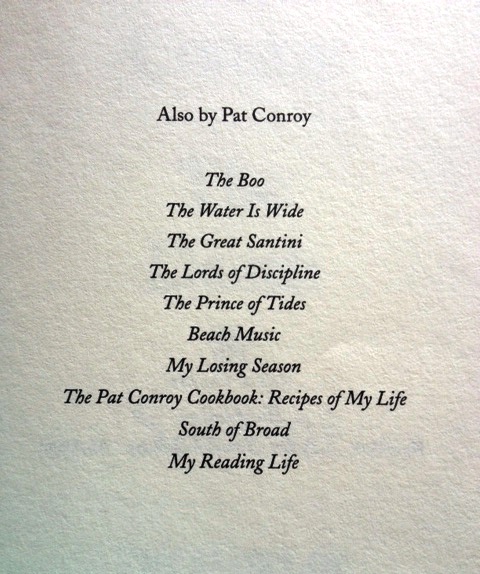
Aaron Roth – Edify.org – “The Distance between Two Blocks” – Dec./Jan. 2015

Greetings everyone, I hope you all had a wonderful Christmas season and a great start to the new year. For the last three months I’ve been in constant travel, with three trips to Guatemala, one to both coasts of the United States and back to Lima Peru.
I have great news to report that we are gaining momentum with the program in Lima, Peru and have just signed an agreement in Guatemala! It’s been an exciting time with many new additions to Edify’s programs and teams, and transitions including my own upcoming transition from Edify to take some time off before I move back to the east coast to start graduate school this summer. I’ll cover that transition in the next newsletter, but in this one I’ll be writing about Guatemala in the newsletter below. -Aaron
In December, I was in Guatemala City working with our newest microlending partner FAPE (Foundation for the Assistance of the Small Business) and we had planned to work on the agreement between Edify and FAPE in the executive director’s home after a meeting. As we pulled into the residential community where the executive director lives I thought to myself, “Hmm, this place looks familiar. Why do I know this place?”
I asked Manuel, the executive director, for the address and wrote down “Zona 13, Aurora II” to research in the afternoon. For some reason, I thought maybe I’d stayed near this place when I first came t o Guatemala almost five years ago. When I got back to my computer I went through my old emails to track down some of the places I’d stayed. Sure enough, deep into the archives I came across the very first place I stayed in Guatemala: a bed and breakfast (really a hostel) that had the address Zona 13, Aurora II. “But these areas are pretty massive anyway, it’s not like it’s that close to his house.” I thought.
So the next day, I asked Manuel, “Have you heard of this bed & breakfast?” and gave him the address.
“Well yeah, that’s just two blocks from my house,” he answered.
It was then that it dawned on me. In almost five years in my journey in Latin America I had progressed just two blocks!
Two blocks.
It felt odd knowing that I’ve gone thousands of miles just to arrive a stone’s throw from where I first began. It feels like I haven’t gone very far, like all the 3am-4am wake up calls for two and three connection flights, logging six to eight, even 10 hours on bus rides into distant communities didn’t add up to a grand total of anything. Maybe I felt a bit disappointed, like a hiker who prepares half a year for the difficult ascent, and arrives to find that they closed the trail and now the summit is accessible by a 30 minute gondola lift.
But that’s not how it is right? There is an enormous difference between the 30 feet that separates the entry-level employee and the CEO. It’s not the measurement of the physical distance at all. If we were to  extend out the years and the experience that separate those two positions the distance would be unfathomable.
Five years ago that first night in Guatemala, I was an anxious young man, fresh out of my corporate job, with feelings of excitement and uncertainty after realizing that the decision to go to Latin America could potentially shipwreck my career or carry me to a new, never before imagined destination. I couldn’t envision what the future would look like, it just looked like a never ending winding road clouded by fog and rain. My only real resolution was to just stay on the path, and try to maintain my momentum and excitement.
So then, five years later from that first night filled with uncertainty for the path laid before me, I was sitting a few hundred yards away, right next to the Vice President of Latin America for Edify, Luis Sena (appears above in the second picture) in the home of the executive director of the  Guatemalan MFI discussing the details about opening up the Edify program in Guatemala.
In that meeting, I didn’t speak of conjecture, but rather from experience. Guatemala is the third country I have worked in, and my responses were from the decisions I have been a part of with my team based on experiences with schools with directors that I knew personally.
I’ve visited hundreds of schools over the past few years, spoken with 12 microfinance institutions and even more training and para-church organizations. I’ve helped write operating manuals for several microfinance projects, written dozens of reports, logged endless  hours in meetings, and presented to leadership teams in English and Spanish.
If only I had known that five years later I’d be a more confident professional sitting with colleagues in a comfortable environment, I would have been relieved of my doubts and fears.
But I know now that in life there are many things that we don’t know at the time, and they aren’t for us to know in that specific time and place where we currently reside.
And that’s ok, the only requirement is that we have faith in the Maker of the paths. The paths of the past, and the paths of the future.
In Edify, we are incredibly excited about the future in Guatemala. We’ve met with two microfinance organizations and visited almost 30 schools around the capital and in three different regions to explore the potential for our microlending program to low-fee independent Christian schools.
It’s been such a blessing to work with our Guatemalan friends, Manuel Garcia and his team, from our first microlending partner in Guatemala. They truly share our mission to work in the economically poor communities to improve and expand these schools that want to serve the families in their communities.
 Trust in the Lord with all your heart and lean not on your own understanding; in all your ways submit to him, and he will make your paths straight. (NIV Proverbs 3:5-6)
So I realize then, that instead of being disappointed in only traveling two blocks, I’m incredibly grateful to realize that the greatest distance the Lord ever required me to go was just two blocks.
If I had really known that and believed in His plan, I wouldn’t have been so worried about the great uncertainty that lay before me. Had I known it would have been just two blocks, I would have jumped out of my seat and started walking, relieved of any great doubts about the plan ahead.
From where I am today, I can rejoice in the great distance between two blocks: for this great adventure with the Lord and his people in Latin America. For all I’ve gotten to experience personally, walking with these school leaders, with men and women so passionate about impacting their communities because that’s what Christ called them to do. He knew that was what was up ahead, and I’m glad they trusted Him and I did too, with only small glimpses of the future he’s preparing. He was, and is, and will be, the Maker of good paths.
I pray that even in moments of uncertainty you have reassurance to know that the Lord has planned out the path you’ll take — even if it is only just two blocks.
Blessings to you all back home,
-Aaron
I saw recently that one of my favorite business authors, Michael Lewis, was promoting the 25th anniversary of his first bestselling book, Liars Poker. In the interview with Stephen Colbert of the Colbert report, they listed off Lewis’ other 

On Monday, I came across an article about the principles of Warren Buffett who, not coincidentally, has had an equal streak of success over the past 25 years in his field, and finds his place not just in the top 10% of performers, but in the top 1%. (You can start making some snide jokes about him being in the top 1% but did you know that he’s a huge philanthropist? article: “Buffett Donates $2.8 Billion, Breaks Personal Giving Record”).
So this article is in a reference to a principle that Buffett has kept central to his life, and explains how he communicated this to his personal jet pilot, Mike Flint:
“Flint confirmed that he would start working on his top 5 goals right away. And that’s when Buffett asked him about the second list, “And what about the ones you didn’t circle?”
. . . To which Buffett replied, “No. You’ve got it wrong, Mike. Everything you didn’t circle just became your Avoid-At-All-Cost list. No matter what, these things get no attention from you until you’ve succeeded with your top 5.” (source: http://jamesclear.com/buffett-focus)”
Seems pretty harsh right? Either focus on those five goals or forget about it all together. Either you’re fully focused on what you want, or you’re not. Reminds me of the quote from Andy Dufresne in Shawshank Redemption:
“Get busy living or get busy dying.”
This principle is seen in modern day sports with the disappearance of the dual-sport and three-sport athletes that once existed in history. It was not uncommon 30-40 years ago for an individual to be a star in two or three sports in high school, and possibly do two sports in college. The rare exception then were those who did it in the professional leagues, but this is almost unheard of today. It simply isn’t possible to compete at that professional level given that other athletes are wholly dedicated to a single sport, not to mention the time involved in preparing for that sport on a day to day basis and the wear and tear incurred on the body during the season.
I remember some parents of friends of mine that would shuttle their children around from practice to other practice and fill their weekends full of physical activity. Now, I think that is good for a child, and still possible for someone in recreational leagues and local community events, but the possibility from both a performance and a feasibility standpoint dramatically declines as the competition increases. We haven’t even addressed where academics fits into all of it.
So if this unadulterated focus toward a single sport might help to explain how people get to the top 10%, but how exactly do people bridge the gap between the 90% and the 10%? How do people improve year over year, stay disciplined and motivated, evade injuries and life-altering decisions, and arrive and stay at peak performance.
The answer, like many responses to great questions, is multifaceted and still mysterious, but
there have been some books that have sought to answer it. One is Outliers, by Malcom Gladwell, famous for saying that it takes about 10,000 hours to get to “expert” status, and as you have seen here on my blog, I think a better, more practical guide is the book that I’m a huge fan of: “So Good They Can’t Ignore You.” by Cal Newport.
In Newport’s book, he expands on Gladwell’s notion on “deliberate practice,” which is continually focusing on improving the weaknesses that will lead to higher probabilities of success, and how to integrate it into a daily routine. He also outlines how to keep focus, concentration and work intensity paramount in the quest for improvement in a given discipline. I have found some of his most salient advice of “No distractions, period.” to be extremely helpful when I work on translation projects or writing pieces. There simply are no workarounds to good work.
So let me turn back to Warren Buffett’s comment to his pilot Mike Flint. I think this is an example of the “No distractions, period.” lesson in a case study from real life. I think we all get that and we all nod our heads in agreement, we’ll say, “That’s good and true about making the top 5 goals a reality, I’m totally in favor of that.” But if you read in the article, Warren Buffett shows a bit of his discipline fanatic side when he responds to Flint. He says it’s not just the principle that’s important, it’s the decision, or rather, the emotional decision that counts.
It’s not enough to agree internally, or even say you agree verbally, but to really make any sort of change you must be willing to cut out what stands in conflict to those goals. That is a far more difficult decision to make than whether to open your mouth and utter the words, “Ok, got it. Just five goals. Totally understood.” Emotional decisions are tough, they are probably tougher to make because we’re not facing visible, tangible choices; we’re trying to choose between things we care bout immensely, things that are related to our life goals, our family, our friends, those we love. Those are the things that pull on the heart strings, the things that keep us awake at night because of adult-laden regret or child-like excitement.
I think the point of Buffett’s comment and the gist of this blog post is that what separates the top 10% from the rest, is not simply their discipline to stick to a schedule, but their tenacity to say no to a bunch of good things to focus on a great thing, a thing that makes a life instead of one that fills a day. That is hard. Actually, it’s really hard. There’s no way around it. It’s something I’ve come to realize over the past few years, that the difference between the 10% and the rest, is not just 90 points on a standard scale, it’s 90 marks on an exponential swing.
It isn’t a ladder at all, it’s a mountain that has to be climbed. If you want to make it to the summit you’ve got to pack your bag with only what’s necessary, and nothing more. Because what you put in your pack will either slow you down or help you get to the top.
I think some of the most popular advice people get is “Don’t give up!” but sometimes that can be slightly misguided right? Certainly there are some circumstances where it’s better to walk away like if a situation or a person compromises your values. That’s not called giving up, that’s actually labeled “not giving in” and can be just as hard or harder than not giving up.
This is another principle that I’ve seen exemplified in some of the writers and some colleagues that I’ve really come to admire. It’s the practice of a belief that something is so valuable that anything that comes anywhere close to tarnishing or damaging it should not just be avoided, but eliminated. I read about some famous writing schedules that impressed me:
“When I am working on a book or a story I write every morning as soon after first light as possible. There is no one to disturb you and it is cool or cold and you come to your work and warm as you write. . . .
You write until you come to a place where you still have your juice and know what will happen next and you stop and try to live through until the next day when you hit it again. You have started at six in the morning, say, and may go on until noon or be through before that.” – Ernest Hemingway
—
“I keep a hotel room in my hometown and pay for it by the month.
I go around 6:30 in the morning. I have a bedroom, with a bed, a table, and a bath. I have Roget’s Thesaurus, a dictionary, and the Bible. Usually a deck of cards and some crossword puzzles. Something to occupy my little mind. I think my grandmother taught me that. -Maya Angelou
—
I tend to wake up very early. Too early. Four o’clock is standard. My morning begins with trying not to get up before the sun rises. But when I do, it’s because my head is too full of words, and I just need to get to my desk and start dumping them into a file. I always wake with sentences pouring into my head.
So getting to my desk every day feels like a long emergency. It’s a funny thing: people often ask how I discipline myself to write. I can’t begin to understand the question. For me, the discipline is turning off the computer and leaving my desk to do something else.
-Barbara Kingsolver
source: http://jamesclear.com/daily-routines-writers)
One clear trend in all of these is that they have a daily writing schedule, that is deliberate and fixed. They do not compromise it. The thought of breaking rank or going AWOL does not enter their mind. They know that the work that they want to do, the good and the great work they must do, cannot be up for negotiation. It must not be left to chance. It is proper and just and right, and for that, it must be respected and planned out.
I love that in each of these there is a certain place that they do their writing. It’s as if that place becomes sacred. Nothing else must be done here unless it is for the purpose of which this place was designed. That’s quite remarkable isn’t it? Creating a specific and deliberate space. I want that.
But it certainly isn’t easy to set out the time and the place to do this! As much as we are creatures of habit it really is difficult to create new ones, or change bad ones. That’s why I’m continually amazed when I read about people’s daily schedules, and how they’ve done it day after day and year after year.
I want to be a non-compromiser when it comes to the good and true things.
A friend asked me recently about the concert I attended for 30 Seconds to Mars and I suppose I summed it up with, “It was loud.”
Jared Leto is the leading front man of the band, and by most accounts of the American Dream he is successful. In addition to being accomplished actor and rock star, he still looks good as a 42 year old. I’m amazed at what he’s been able to do in the life he’s been given, and how he continues to make it new and real with his stage presence like in Lima, Peru the other evening. There are thousands and thousands who’ve joined the official “Echelon” fan club and feel uniquely attached to him. I don’t know if any of that has to do with that with his current hair style he looks like Jesus, but that night it seemed like his love for them was mutual.
I first began to listen to 30 Seconds to Mars because my brother let me borrow an album. Their 2005 album “A Beautiful Lie” marks a trip to the Southwest 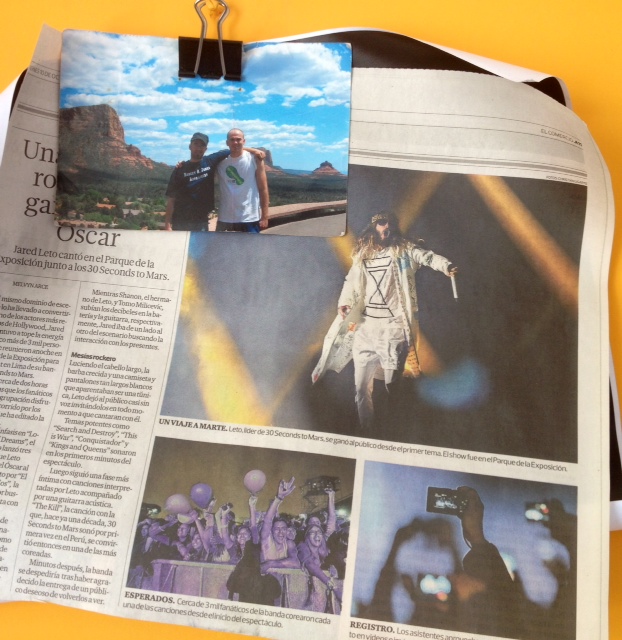 desert I made with my brother in 2007, of which a picture hangs in my room. I remember most of those songs as a soundtrack to the strange and alien-like territory of the Arizona desert. They all sound like freedom, of a wide expanse of sky and tanned earth, of new possibility, and I know that the trip, my brother, and those songs are the landmark of a time period that set in motion the dramatic changes I would make in the years to come.
I had always wanted to see 30 Seconds to Mars in concert for their music and for experiences like the desert, and it took almost seven years after that first listen for me to finally see them live. I carry with me certain desires that I just can’t let go, especially if I know they are possible. Seeing 30 Seconds to Mars for their music, for the mark they helped make seven years ago, for the completion of a goal was why I went to see the show that night, and it was everything I needed it to be.
My thoughts were illuminated by the army of synchronized stage lights as Jared sprinted like a boy out of school for the summer. It felt and sounded like a hundred explosions, and part of me thinks that’s part of the energy released by the fans who waited years for the band to come. (They had never visited Peru, up until this date.) I thought about all the waiting, and the excitement and the fact that in approximately an hour and a half the concert would finish. I thought about what I’ve done (and not been able to do) in Peru and it all just seemed to make me a bit sad that someday it’ll be over.
What an injustice. We spend so much time waiting for something important to arrive, and when it does, it touches lightly on our stop, and speeds on to it’s next destination. It feels so disconnected: the time waiting, and the time experiencing. Maybe that’s my problem, that it seems to be related, but really it’s so callously independent. I hope that’s what Jared recognizes too. That we, like him, wait for something, and that we know, ashamedly, that it will end quickly. Are we ashamed that we were bound by something we had to wait for, or because we felt we had no choice in the matter?
I remember reading Dylan Thomas in college. My English professor enjoyed him and T.S. Elliot, so that’s how I got introduced, but for most of America we know of his famous poetry because a stanza was once paraphrased in Independence Day. It’s from the same poem I remembered in college, and the one I drifted towards this concert night, “Do not go gentle into that good night.” Dylan wrote it about his experience of his dying father, but the words, so brilliantly infused with emotion, have been used by coaches, leaders and politicians for decades:
Do not go gentle into that good night,
Old age should burn and rave at close of day;
Rage, rage against the dying of the light.Though wise men at their end know dark is right,
Because their words had forked no lightning they
Do not go gentle into that good night.(source: http://www.poets.org/poetsorg/poem/do-not-go-gentle-good-night)
I returned to the thought about the magnificence of a person like Jared with this notion of things ending much sooner than we think they should. I think consciously or unconsciously he knows that; like many people great and  popular, and others great and still unsung, they realize that life indeed is so very short, and ends before we’re comfortable with it. Indeed, we are not the masters of our time.
For that reason, I believe that when Jared and his brother, Shannon, arrived for their first concert in Lima they did it in such a fashion of extravagance of sound and energy to prove to us that even though an end will eventually cap the evening, and the thousands of miles and mountains of hours, indeed the years waiting for their arrival, will all feel like the brush of the wind from the passing of an express bus, they will stand before the multitude of eager and spellbound fans and will not go quietly into that good night.
Because if death marks its end with silence then we must be loud to mark the time we were alive.
The concert, then, was very loud. It was loud for the thousands of fans who waited for their first arrival to the country, it was loud for the band to see the love and Echelon banners flown in the multitudes, and it was loud for me to bring completion to something I wanted to be a part of for so long.
Most importantly, it is yet another reminder that there is still too much silence in my life. That there will be a time to be quiet, but that time is not now.
I think we all know “what.”
“What” is fundamental. Knowing “what” is easy. What we want and how much we want of it.
It’s knowing “how” that really gets us anywhere, but there’s a crucial key to this – it’s not so much “how” you intend to do it, but “how” you are doing it. One is about planning, where anything can happen – including nothing happening – and the other is about “doing” which is actually wants happening.
As soon as we’ve moved passed the knowing “what” and the knowing “how” we can go to the “how” it’s getting done. This kind of “how” has been a recurring life theme for me.This is truly the difference between thinking about something, and wanting it, and then actually saying you’ve done it. I can put many things on this list that I haven’t done as much as I’ve wanted to: reading, writing, and practicing Spanish (and most recently Portuguese). What I’ve found is that there is always a barrier, or in fact many barriers, but the one I want to write about is the “feeling accomplished after just the planning stage” barrier.
That’s what gets me. I can dream up, and plan out all that I want to do with my time during my weekdays or my free time, and I feel satisfied. That’s dangerous you know? Because nothing comes of it. Nothing happens unless something is set in motion and is done.
Sometimes I get so caught up in strategies, technologies, tips and tricks that I end up spending more time optimizing what I’m kind of doing instead of really doing what I intend to do, and oddly enough what it final comes down to is just a simple decision: doing it. Don’t think, don’t plan, don’t optimize, don’t strategize, don’t worry, don’t complain, just do. Just do it without thinking.
What is easy, doing is how it’s done.
Since I’ve been in Latin America I have immersed myself into the local music. If you look at my playlists you’ll find artists from all over South and Central America in the genres of merengue, bachata, and of course tons of salsa music. I’ve seen that learning to love the local music is a surefire way to experience and enjoy a community in every town and city in the world. Music is a main outlet for the values and expressions of a culture, and as many have said, “Listen to what the music is about, and it will show you  what a culture appreciates.”
You may be thinking of some of the more negative examples from the dominant channels of music in our culture which showcase people who look like celebrities but carry none of the talent. Their music is formulaic, the lyrics are empty and derogatory, and all of it is manufactured for consumption. Here’s is just one of many articles that speak of this new business. The Song Machine – “The hitmakers behind Rihanna.”
Essentially, the artist never has to dip into personal memories, be they mountain or valley experiences, they just show up to learn the melody and sing it good enough so someone can auto-tune it to the studio producers’ liking. The concert experience, then, is just going to hear the digitally perfected album played over loud stadium speakers with thousands of shouting voices that drown out the song. Now, I admit, I will go to just about any concert, so this element  doesn’t destroy it for me, but what bothers me is that the principle that music is an expression of a culture is now so absent in the performance of the music. Is that what we value?
Enter one of the great salsa voices of our time, Marc Anthony, the top selling tropical salsa artist of all time, who like many salsa singers, sings with a complete band. Marc sings live accompanied by an orchestra of talented professionals. Real people, playing real instruments, in real-time. You have to see it and hear it to believe it, but yes, there are still performers who do it the old fashioned way. They make real music live.
It had been a dream of mine to see Marc Anthony live since I set foot in Latin America over four years ago. He has one of the truest, purest voices that I rank up there with Michael Buble, and Josh Groban. You have to hear it live to take it in. His voice is the story of pain and joy, of happiness and despair, and this past night it was pure celebration.
And then there was the orchestra, comprised of the best instrumental talent of men and women that we have today. Trumpets, trombones, saxophones, guitar, bass, piano, full drum set and Latin bongos. The orchestra alone was worth the price of admission, but together it was one of the greatest concerts I’ve ever been to and I got to share it with my girlfriend and thousands of other Marc Anthony fans.
Here’s what it was like, but you’ll have to multiply it by two or three times to get the real effect:
I know you’ve heard his most recent hit:
Aaron Roth – Edify.org – “Neighborhood Missionaries” – Aug/Sept. 2014
I’m still in Peru working with the local partner to establish the first few schools of our Edify program in Lima. We had a big school conference last month where over 50 schools and approximately 240 participants came to learn about our program, receive business training and Christian development training for their school. I hope to update you all on our progress this coming month, but let me use this newsletter to talk about a family very close to me in the Dominican Republic. -Aaron
I have had many unique experiences over the past four years in Latin America and most of them have happened while living with a local family. “Live with a family” is usually the advice I give to anyone considering taking the time to study a language. I believe that language is really about living life, and there’s no better place to live daily life, than
 with a family.So for that, I have to credit most of the Spanish I use every day, to the experiences from all the birthdays, church services, buying strange foods and eating them, and the endless cultural or language faux pas I’ve committed. But it’s not just words and phrases I picked up from them; I have learned a tremendous amount about local culture, and how to understand that very culture I intend to serve, and how living a life of witness goes even deeper than simply proclaiming those words.
Inside the American church, I had often felt like the perspective of a ready missionary was to “go, serve, and witness” with a heavier focus on the “witness” than on the “serve.” Christian witness of course is the application of the great commission of Christ, commanding us to go into the world and make disciples in the image of Christ. (Matt. 28:19) But what that often implied to me was that the people we were going to go witness to had no idea who Christ was and needed to be introduced to him through the formal methods of evangelism. Of course, as any short or long-term missionary can attest to, the ones being “sent” from the United States, end up “receiving” a good deal of the transformation themselves in the process of witnessing, or intending to transform the local community.
And so it was with me. I have had the great blessing of being able to live life with three different host families: in Guatemala, in Nicaragua and in the Dominican Republic, and I

The reason why still fascinates me to this day. Apparently, about 10 years ago one of their children fell incredibly sick and needed better health care outside of the Dominican Republic. Through a sponsor, Rebecca was able to take her sick child to the United States and during the three months, a family from a church (I believe it was in Ohio or Michigan) took her and her son into their home. (Sadly, they lost that son to a terminal illness during that visit to the States). This family treated her like one of their own, and she knew that someday the Lord would call on her to do the same thing.

So there I was, “the caller,” in the fall of 2010, being welcomed in with open arms and being crawled over by their two sons, Josias of four years and Railyn of eight. Thus began one of the most remarkable periods of my life – living with a Dominican family in the ghetto – and experiencing all that happens on a day to day basis, just like another child of the family.
So let me tell a quick story: one day, I was at home and I received a knock at the door from Rebecca’s sister. She was in hysterics because her daughter was having complications during the delivery of her child and was losing blood rapidly. Because of the economic conditions in that area, the clinic where the girl was a patient would not dispense the necessary blood until an economic sponsor came to pay for the procedure and the blood. This is an all too common story in these tough areas: lack of insurance and lack of paying clients pushes these health clinics to accept these kinds of policies.
I told Rebecca’s sister that the boys and Federico would be home soon, and soon after they arrived, Rebecca came rushing in after leaving work early in the only car the family owned. Federico and Rebecca were calm, and even though I had only been a “son” for two weeks, they entrusted me with their boys, and raced off to the clinic to purchase the blood so that their niece and newborn would live.
There are countless stories that impacted me over the past four years with them, but maybe the most impressive thing was how a story like this was a regular occurrence where the family did what Christ called them to do. They consistently made the right decisions, to  love, to not ask questions, to respect, to stand firm, to ask questions, to forgive, to be just, and to practice grace.
On my last visit with them exactly two months ago, Federico was busy in the men’s leadership of his church organizing and managing the disciplining program which paired up older men of the faith with younger men, some of who never grew up with their fathers. They also had a niece staying with them who has had some trouble at home. And like always, when we had a meal, instead of just the six of us, they prepared enough food for the three cousins, and two neighbors who just dropped on by.
You see, their definition of “family” and “witness” are one in the same.
—–
What I believe happens overseas is that most of these heroes of the faith go unsung and their stories diluted. The American church gets the filtered and friendly stories from their representative abroad (like yours truly). While this isn’t optimal, it’s certainly not terrible, because I believe that the spirit of the story makes its way to you and people like Federico and Rebecca never go looking for any kind of acclaim. They just live their lives following the example of Jesus in the neighborhood where God has called them.
That I believe is what a true missionary is. Someone who listens to God’s voice in their life, relies on the Holy Spirit to guide them to live the life that Christ calls them to live.
So then, it is with incredibly sad news that I tell you about the death of a fellow missionary.
—–
Last week, someone had emailed me that Rebecca was very sick. I didn’t know this person so I inquired with some friends to call the family. At just about that time, I received another email telling me that Rebecca was in grave condition in the hospital. It was

Because you see, Rebecca, was my mother too. Her children were my brothers, and her husband was my Dominican dad. They were the people that helped to center me during my two years in the Dominican Republic and translated so many Dominican slang into common Spanish for me. They were the people that helped me understand that if you really wanted to serve people in the name of Christ it had less to do with shuffling papers and managing inboxes and more to do with being present in a community that desperately needed His hope.
Federico and Rebecca showed me that the first mission field is the family, and they have raised two great young men. On my last visit, their sons showed me their report cards from school, and told me how even though they didn’t like homework, they still knew it was part of their daily schedule. Josias was improving in his English, being quite the talker like his American brother (me), and Railyn had already memorized the books of the Bible and could recite to me memory verses from the past month.
What you also do not know is that while I have been working in microfinance for roughly four years, Rebecca was a branch manager of a microfinance organization for about 12 years. Often we talked about the need for access to credit for the economically poor, and how the follow-up after making the loan to continue with the relationship was more important than the loan itself.
She loved the idea of providing small business loans to low-cost Christian schools like what we do in Edify. She would have carried the banner for that idea in her organization, because she believed in education in the home.
—–
I know what Rebecca would do if she knew I was writing about her. She’d smile and brush off the compliments with a simple response that she had told me many times:
“If this is who you are, then this is what you do.”
“Since, then, you have been raised with Christ, set your hearts on things above, where Christ is seated at the right hand of God. Set your minds on things above, not on earthly things. For you died, and your life is now hidden with Christ in God. (Colossians 3:1-3 NIV)”
She really did live like she had her heart on the things of heaven, and I know her family will continue her legacy.
—–
Would you pray for her husband, her two boys, their niece, and all her family in their time of grieving?
Thank you for listening. My prayers be with all of you as well.
Blessings,
-Aaron
 Aaron Roth – Edify.org – “Family Experience Camp” – July 2014
I’m back in Lima, Peru after almost five weeks in the Dominican Republic (DR). The weeks in the DR seemed to fly by very quickly because after the first week with two colleagues from ADRA Peru (our Peruvian partner), I headed to the eastern part of the island to work with the Edify Family Experience Camp for the following three weeks. It’s a really quick turnaround from week to week because we drop off families and pick others up at the airport in addition to working in three different schools in La Romana, DR.
Between week 2 and 3 I flew home for my dad’s retirement celebration. We celebrated his 34 years in the pastorate and 19 years at the Linville Creek congregation in Broadway, VA. As you can imagine, it’s nice to be back in Lima, Peru not having to travel for awhile. The following newsletter is about the three weeks of the Edify Family Experience Camp of 2014. -Aaron
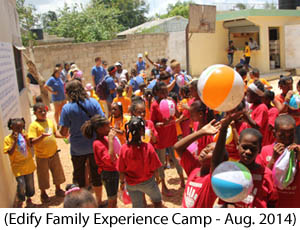
Our purpose for having these family experience camps is to bring families from the US closer to the realities of the areas of economic poverty where we work and to celebrate with a few schools in our loan and training program in the Dominican Republic. We call our trip more of a “Vacation with a Purpose” instead of a “Mission Trip” because the week is geared toward a relaxed family environment where we spend part of the day in the school with children and part of the vacation time doing a book study using “When Helping Hurts” by Steve Corbett and Brian Fikkert.
 By having the ability to experience different economic realities during the day and discussing these differences using a technical guide, we allow guests to learn the theory at night and see it in practice during the day. I believe this is very important for our guests – including our staff – because when you have an open discussion on what works vs. what doesn’t, and what helps vs. what hurts, everyone benefits and we reduce the tendency to think of ourselves as superior, wealthier Americans with a lot to give and foreigners who are just waiting to receive.
Instead, we’re able to sit at a common table where all of us see our areas of poverty: relationships, time, value, unhappiness and distance from God, and we seek solutions to alleviate these areas of poverty. We are very well aware that any form of development takes much longer than a week, including the development of a new perspective, so we really try to encourage guests to come with an open mind and plenty of flexibility, so that the Lord will show us what He desires we see. I like this laid-back approach much 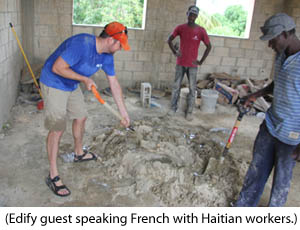 better than trying to mandate the feelings or conclusions people come away with.
When you push and you pressure, it’s less fun and less effective, so really what it comes down to is being open to see what God has for the week, and naturally relationships will form and flourish in that environment. In a way, we can learn how we can better treat the people we work and live at home by experiencing another culture.
Our theme for this past summer was a verse from the parable of the “Good Samaritan” in Luke where a man responds to Jesus’ question regarding what he must do to inherit eternal life:
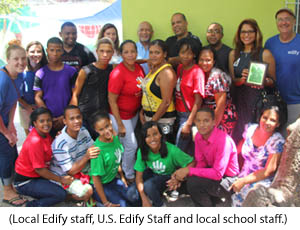
He answered, “‘Love the Lord your God with all your heart and with all your soul and with all your strength and with all your mind’; and, ‘Love your neighbor as yourself.'” (Luke 10:27 NIV)
Each day we try to instill more applications of the principles in the verse to the students in the family camp. After each week, each participant collects their own stories from the previous week. Here are a few stories that I took away from family camp this past summer that demonstrated what it means to love your neighbor as yourself.
Ruth & Esmerelda
In the first week of family camp, we worked inside a school called, “Paso a Paso” or “Step by Step.” I remember meeting Haidy, the director, over two years ago when we promoted business training for schools in La Romana, Domincan Republic. She is a mother of a special needs child and when she saw that no public school was giving him the attention he needed to develop, she created her own school to attend to students with certain development needs.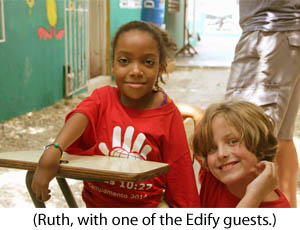
Now, more than 10 years later she has a school with over 100 children that come to receive a great Christian education, and not all the students are special needs, but it is quite amazing to witness how the other classmates treat the students with special needs.
Ruth, who has limited functioning in her hands and arms, and very limited ability in her legs, sits and draws with the other students in her class. When she needs to move to a new classroom, a student will pick her up, and when she needs to go to the bathroom a teacher or the director will help her. She’s quite intelligent and social, and is probably a little timid given her inability to run around with the other kids, but regarding timidity we could of course chalk that up to the fact she’s a 4th grader.
Meet Esmerelda, she’s just as sassy as any other six year-old Dominican girl. She wants to be a part of everything. Every game, every activity and every photo. You’ll take a photo, show it to her, she’ll shriek that it’s not her best, so you’ll have to take another one. At times, you can say  she needs a bit more management because she has Down’s syndrome, but you could also say she’s tuckered out from being around so many people she wants to meet.
Ruth and Esmerelda are treated like their other classmates. Do you know how profound that is for a country that is still in its “developing” status? They are accepted and loved like they weren’t any different from the others – and hey, aren’t we all a little different anyway?
Willie and the Car Workshop
One day, after a few school visits, one of our transport vans didn’t start up. We loaded the rest of the guests into the other vehicles and they headed back home while I met up with a local mechanic to go see what we could do about the problematic van. I was dropped off at his workshop which was mostly a small parking lot with some temporary canvas awnings blocking the heavy sun off the workers. I counted about five mechanics ranging in age from 18 to 50 and two more young teenagers. 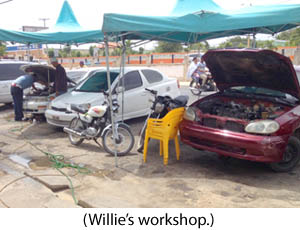
As I stood there for about half an hour waiting for Willie to clear some time in his schedule to go visit the distressed van, I got to see the local operation of his car repair business. I must have seen seven or eight different conversations or transactions between the mechanics, delivery men and other visitors. I felt like I was in the middle of some shipping docks with a few ships of different shapes and sizes arriving and leaving at the same time, offloading goods, boarding passengers, repairing components and asking technical questions. I was amazed that no person nor transport collided; Willie had it all under control.
Finally we set sail for the van, and I got the chance to ask Willie about his fleet of workers. “ . . . and what about the two young men, do they work for you permanently?
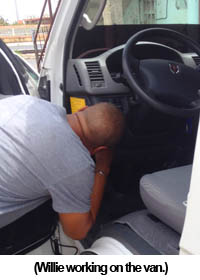
“Well, half the time. They are in school during the year, so I only let them work with me half a day. They are crazy about learning about engines and components and repair. If it were up to them they’d sleep in the workshop. I told them they need to be in school. I won’t hire them full-time until they finish school. That’s the deal.”
I saw not only why Willie was a great manager, but also why he was a great man. Someone treated him just like he’s treating these young men: with guidelines and a gentle strictness to a good principle. Someday they’ll thank him when they are managers of their own repair shop yelling at young workers to stay on schedule or grab some parts from a supplier. They’ll see that he had their destiny in mind the whole time.
La Familia Ortiz
After a total of six family camps I am pretty sure that the oldest group, ages 12-13, is where I belong. Not because this is my actual maturity level, but because they are older and you can have real conversations with them. I normally refer to them as “Los Verdes” or “The Greens” because of the shirt color we give them, but I normally give them an option of choosing a new name. I try to convince the boys that they should think about really manly titles like “Little Rabbits” or “The Flowers.” They don’t usually go for those, so this year when I had the greens one week it was “The Disciples” and the other was “La Familia Ortiz.”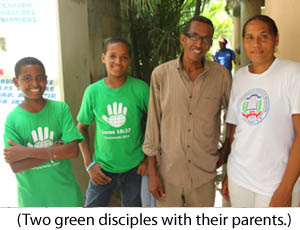
One of my common topics in newsletters come from the “things I don’t get used to” and how the green group chose “La Familia Ortiz” has its roots in that. I find that the young guys are really keen on knowing who I am and what I think about a variety of topics. It’s like they are looking not just for an older brother, but a positive male leader. I don’t think I’ll get used to hearing the young men tell me that their father left at such a young age, or they’ve never met him, or they only know him when he flies in by night usually with alcohol on his breath. I definitely am not used to that. I try to be different; I try to be a better man than they’ve known, even if it’s for a week.
The school we worked with told all the students that we were friends of the school, and these Americans were really more like uncles and aunts than guests. So with that warm introduction, they wanted to know who I am what I think about their community and if I’ve thought I could ever live in the Dominican 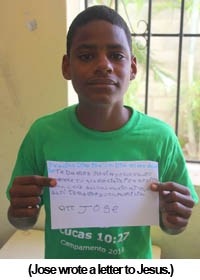 Republic for a long time. They want to connect, so they asked me what my last name is to find their uncle, me, on Facebook. I joke with them that I don’t know it, and when I ask for suggestions for last names I ask them who some famous Dominican baseball players are.
After hearing a few examples I say, “Oh yeah, Ortiz! That’s it!”
They respond in disbelief, “Aaron Ortiz! Seriously? You’re Aaron Ortiz!?”
“Yes, so with a more Dominican last name I guess that makes us a little more like family right?”
“Yes! La Familia Ortiz!”
“Well, what do families do here?”
“We get together and have big meals. Big barbecues, everyone is invited.”
“I think that sounds like a fantastic idea.”
“Aaron, when you come back we should all have a big bbq for La Familia Ortiz!”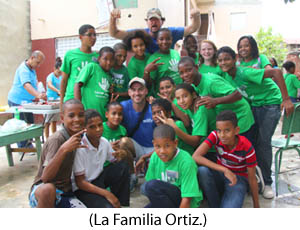
It crushes me each time when I think about how “coming back” is a promise that will be very difficult to fulfill, so I tell them that our organization works with the schools directly, and we have a lot of schools in the program in the DR, so really we are all family. So when we get together as believers in one faith, we get to celebrate with family. It doesn’t matter the country, the community, the language or the skin color. We’re all family.
They loved it. Every time we had to round up the groups, they shouted, “La Familia Ortiz! La Familia Ortiz!”
On the last day, they shouted that we needed our family photo. Many kids wanted individual photos with Uncle Aaron Ortiz. It was so fun. But then of course comes the part where the young men show their weakness. The same young men who tell me their stories, don’t just ask me, but really want to know, “So you’ll come back right? You’ll come back here for the bbq?”
What do you say to something like that? Normally, I’d say, “If it’s soon, or if it’s later, you know we’re still La Familia Ortiz right?” They smile and shake my hand, “Sí, somos de la Familia Ortiz.” (We are the Ortiz Family.)
Bernie and His Older Brother
One of our guests at Family Camp, a long-time Texas Rangers fan, and current little league coach, suggested to me that we should try to play a pick-up game with Bernie, a student from the school, and his friends. He had an eagerness in his request not just that he was interested in seeing the talent of Bernie, but that he and his son would enjoy a more personal connection with local students in a common passion for baseball.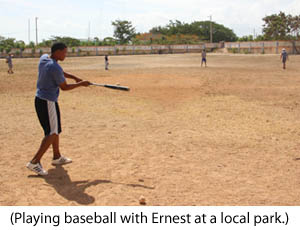
We made the arrangements during the breaks of family camp with Bernie and assured him that we’d come ready to play, and yes, of course his older brother could come to. But why was Bernie so insistent on his older brother participating? As it turns out, Ernest, now 20 years old, just three years ago was selected into the development academy for the Baltimore Orioles, but unfortunately, on the day he was to sign his contract for a triple A team in the U.S., an all too common story occurred – they simply didn’t have room and he was dropped from the roster.
So on Thursday afternoon there we were, four Americans, with Bernie and friends catching fly balls and turning double plays in the scorching Dominican heat on a rocky and grass-barren field just outside the local stadium. What was amazing to note was that his older brother, Ernest was indeed talented, a true natural, but what impressed us most was his father-like care for his younger brother. I spent some time talking with Ernest asking him about his plans. He told me that he’s still playing baseball, and is hopeful to get picked up again by some scouts, yeah, he’s working a little bit, and really he should finish his degree soon.
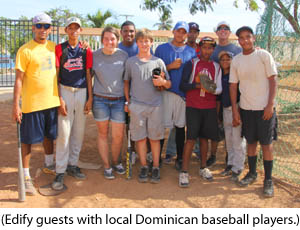 I asked him about what he thought of his younger brother, “You know, he’s the real natural. When he gets his growth spurt, I think he’s got potential. But I don’t want him to go down the road I did. I want him to have a better future. I want him to finish school first.”
I played that conversation over in my mind, and a question stood out to me: “What do we leave, when we leave the island?” Do we come to see the sights and sounds and taste the local flair, and applaud the talented youth? Because we will come, and we will go, that much is true. But what impact will we make with our time, with our resources, with our energy? To a young man, who had seen the real promise of a dream on ink and paper, and in one day seen it taken all away, I see that he desires the surest route for a better future for his younger brother.
That I believe is what he wants us to cheer for, that is what he hopes we will bring to the island and how we will treat our Dominican neighbors.
—–
I pray that you’ve been having an enjoyable summer and have had the opportunities to be involved in your community. Please pray for us here in Lima, Peru as we continue to implement the Edify school loan and training program.
Blessings,
-Aaron

